Customer Activity Automation
ROLE/TEAM
I plan, design, oversee and maintain the project
TIMELINE
1 month
Year: November, 2025
TOOLS USED
Google ADK, A2A protocol, MCP, Gemini model, Loop and Sequential Agents,
User inactivity is often an early signal of churn. When customers stop logging in, forget about features, or encounter friction, the likelihood of disengagement increases significantly. The real challenge was not identifying inactive users once in a while, but the absence of a scalable system that could continuously monitor activity, take appropriate action, and escalate issues without human intervention.
The goal became clear: build an automated workflow that monitors user activity, responds intelligently based on inactivity duration, and reduces manual effort while improving customer engagement and retention.
I designed and implemented an automated, agent-based workflow that continuously monitors user activity and triggers the right action at the right time. Instead of engineers manually combing through logs, the system evaluates user behavior in seconds and handles communication and escalation automatically.
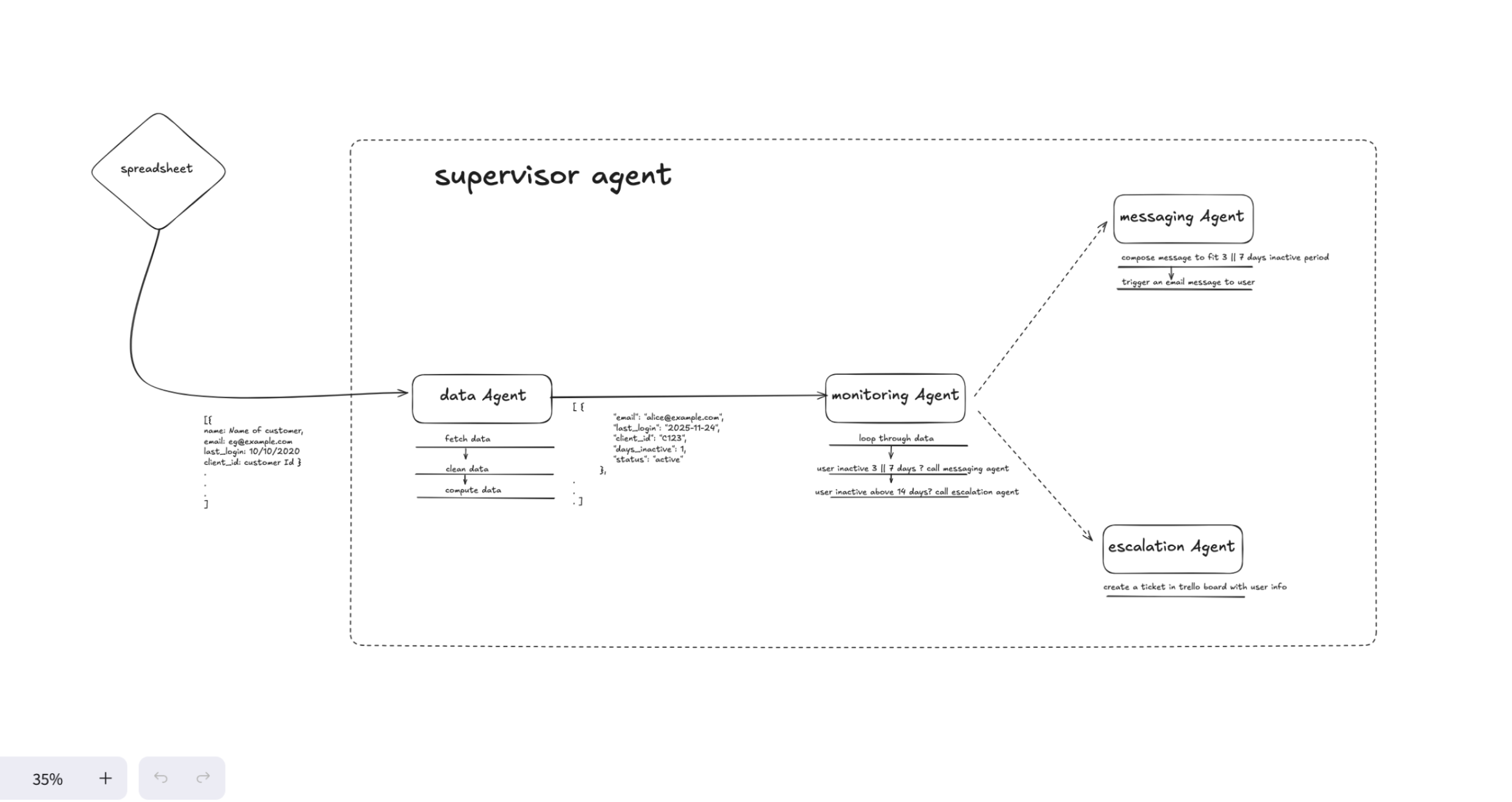
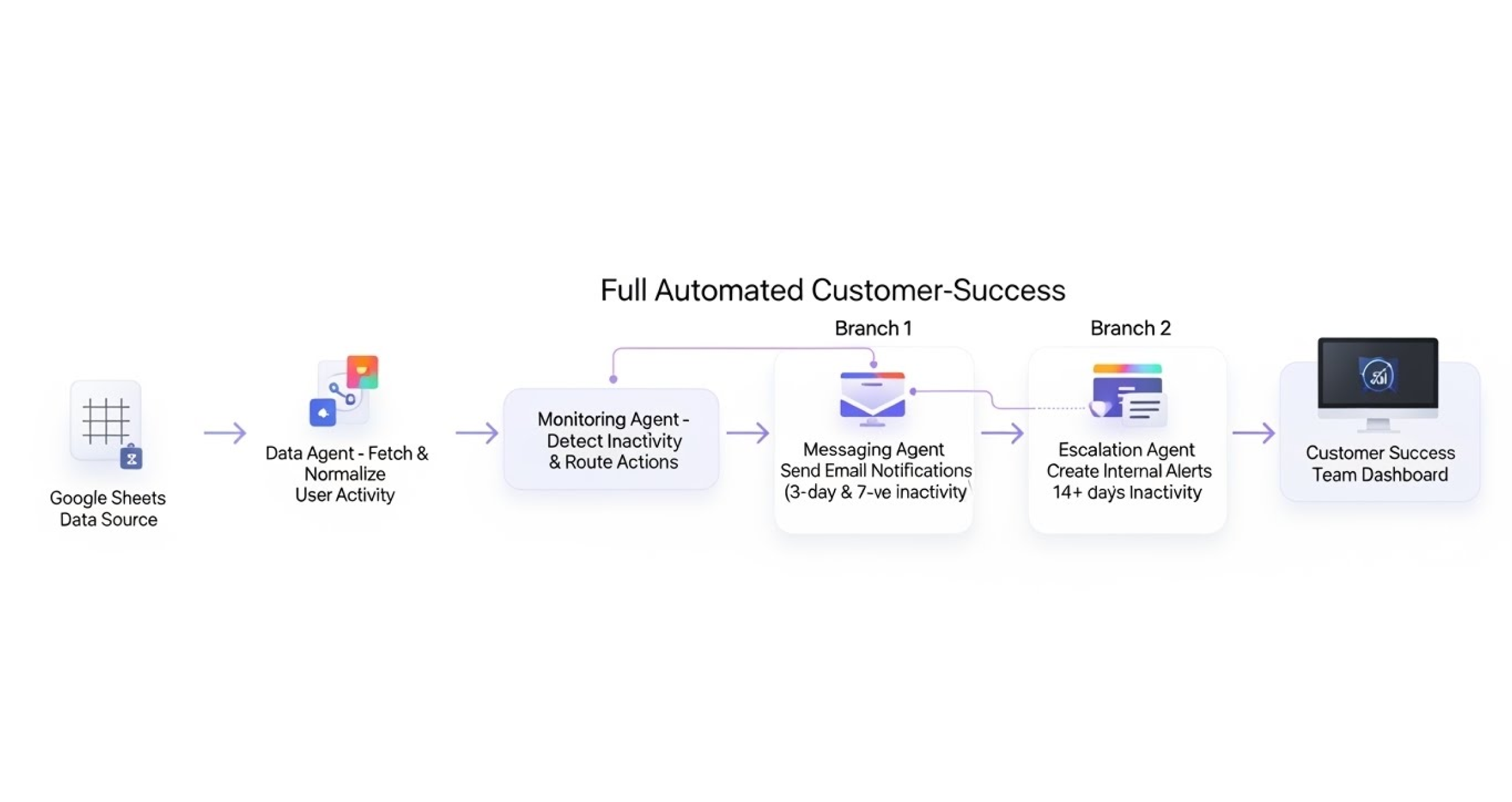
The workflow is composed of multiple specialized agents that collaborate to monitor users, send timely messages, and escalate critical cases to the Customer Success team.
The system begins with a data source that mimics production user data, containing information such as email addresses and last login timestamps. A dedicated data agent retrieves this information, cleans and normalizes it, and calculates how long each user has been inactive.
A central monitoring agent acts as the decision-maker. It evaluates each user’s inactivity duration and determines the appropriate next step. Users with minimal inactivity are ignored, those showing early signs of disengagement receive friendly reminders, and long-term inactive users are escalated for human follow-up.
When user-facing communication is required, a messaging agent generates and sends personalized emails based on how long the user has been inactive. For more severe cases, an escalation agent creates internal summaries, flags accounts as at risk, and notifies the Customer Success team by creating actionable tasks in a CRM-style system.
Overseeing the entire process is a supervisor agent that logs system activity, tracks execution timelines, and produces high-level summaries of user engagement patterns. This ensures observability, accountability, and reliability across the workflow.
What previously took multiple engineers several days of manual work is now handled automatically in seconds. The workflow eliminates repetitive operational tasks, reduces human error, and ensures that no inactive user goes unnoticed.
More importantly, it enables the business to act proactively. Customer Success teams are notified at the right time, users receive timely and relevant messages, and at-risk accounts are surfaced early. This system transformed user inactivity from a reactive problem into a measurable, manageable, and scalable process that directly supports customer retention.